The US Playbook
A Reference for Understanding Global Conflict
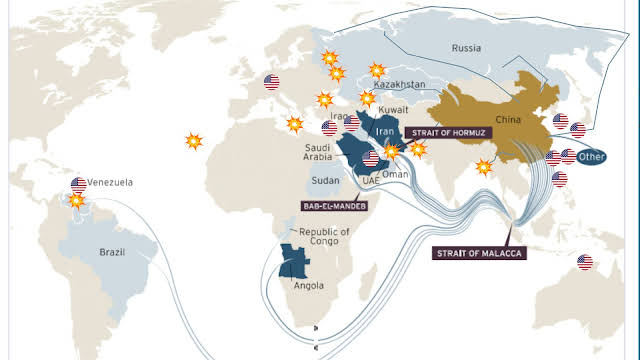
The One Sentence That Explains Everything
Every significant US military, intelligence, economic, and political operation around the world is a component of a single, decades-long campaign to prevent China from surpassing the United States as the dominant global power — primarily by cutting off China’s energy supply, isolating it from its partners, and encircling it militarily until it can be contained, destabilized, or collapsed.
When you are confused by any news event anywhere in the world, return to this sentence first.
The Core Strategic Logic
The United States operates on a straightforward but ruthless premise: whoever controls global energy controls the global economy, and whoever controls the global economy controls the world. China’s rise threatens to permanently end American unipolar dominance, and American institutions — specifically the Wall Street-aligned corporations in the arms, oil, technology, agriculture, and pharmaceutical industries that have always driven US foreign policy — are not willing to accept that outcome voluntarily. They will never voluntarily accept it. This is not a recent policy. It is the continuation of an imperial project that began when the US was founded as an extension of the British Empire and has never stopped expanding.
The critical timing pressure is this: every year that passes without decisive action, China grows stronger. Its military expands. Its economy deepens. Its energy independence increases. The US therefore faces a closing window, and everything you see happening right now is the US attempting to act through that window before it shuts permanently. This is why events that look chaotic and disconnected are actually moving with purpose and urgency. The US is not stumbling into these conflicts. It is racing into them.
The Ultimate Objective: A Global Energy Blockade on China
The strategic endgame the US has been building toward — documented in its own policy papers, force restructuring programs, and military deployments — is the imposition of a comprehensive maritime energy blockade on China. A 2018 US Naval War College paper literally titled “A Maritime Oil Blockade Against China” describes this openly. The idea is to seal off the chokepoints through which China imports the energy that runs its economy — primarily the Strait of Malacca, but also the Strait of Hormuz further west — using US naval and Marine forces that have been specifically restructured and re-armed for exactly this anti-shipping, strait-interdiction mission.
But a maritime blockade alone is not sufficient. China has spent years building overland bypass routes — pipelines through Myanmar, through Pakistan, and through Russia — precisely to hedge against this threat. So the US is simultaneously attacking every one of those bypass routes as well, through a combination of proxy wars, CIA-directed covert operations, and direct military force. The blockade is therefore not just maritime. It is global. It targets every energy artery feeding China from every direction at once.
The Fronts of the Global Energy War
To orient yourself, understand each major conflict zone as a specific front in this single war:
Venezuela was one of China’s most important oil suppliers in Latin America. The US invaded, kidnapped the president, and politically captured the government in early 2026. Venezuelan oil exports to China are now severed and redirected to the US. This front has already achieved its objective.
Iran and the Persian Gulf are the centerpiece. The Middle East is the largest and most productive energy region on Earth, and China depends heavily on it. The US war against Iran — laundered partly through Israel — is designed to destroy Iran’s military capacity, degrade regional energy production, and position US forces to control or close the Strait of Hormuz entirely. Even if Iranian ships still pass through the strait, US strikes on energy production infrastructure reduce the volume of energy available to export. The war also degrades Saudi and Qatari production as collateral damage. This is not a war for Israel. Israel is a tool. The war is about who controls the energy flowing out of the region and whether China can receive it.
Russia is being attacked on two simultaneous tracks. The CIA — confirmed by the New York Times — directly directs drone strikes on Russian oil production and export facilities deep inside Russia, using Ukraine’s intelligence agencies (which the CIA has controlled since 2014) as the operational cover. Separately, European proxies are now seizing Russian energy tankers at sea under the cover of “shadow fleet” enforcement. Both tracks target the same thing: the energy Russia ships to China. The US proxy war through Ukraine was never primarily about Ukraine. Ukraine is the instrument. Severing Russian energy exports to China is the objective.
Myanmar hosts the China-Myanmar oil and gas pipelines — a critical route allowing Middle Eastern energy to be offloaded on Myanmar’s coast and piped directly to China, bypassing the Strait of Malacca entirely. The US has spent decades building a political opposition (the NUG, headquartered outside Washington DC and funded entirely by the National Endowment for Democracy), arming militant groups through operatives like Matthew Van Dijk and David Eubank’s Free Burma Rangers, and directing those militants to attack the pipeline infrastructure specifically. The 2018 Naval War College blockade paper names this pipeline by name as a target that must be interdicted. Americans and Ukrainians were arrested in India in March 2026 mid-operation, confirming this front remains active.
Pakistan hosts another overland pipeline to China. The US has been backing terrorist attacks on that infrastructure for years through the same general playbook applied in Myanmar.
The Asia-Pacific encirclement is the military architecture meant to enforce the blockade closer to China itself. Japan is deploying missiles to islands 110 kilometers from Taiwan. The Philippines has been steered by US-interfered elections away from Chinese investment and toward US missile bases, including one only 185 kilometers from Taiwan. Tens of thousands of US troops are stationed across Japan, South Korea, Australia, and the Philippines. US troops are present in Taiwan, which is legally recognized — even under US policy — as Chinese territory. All of this mirrors what the US did to Russia by expanding NATO to its borders and to Iran by stationing forces in Iraq and Afghanistan on both its eastern and western flanks simultaneously.
The Playbook: How the US Executes This Strategy
Understanding the consistent methods the US uses across all these fronts allows you to recognize the playbook wherever it is being run, even in countries or contexts you are unfamiliar with.
Step one is political capture through the information and electoral space. Before any military operation, the US spends years — sometimes decades — building a client political opposition inside the target country. The primary instrument is the National Endowment for Democracy, which was created by the US government, is funded annually by the US government, and is overseen by the US government, making its claim to be a non-governmental organization functionally fraudulent. The NED funds political parties, media outlets, youth organizations, labor unions, election monitoring bodies, and university programs in the target country, systematically tilting the information environment and the electoral system toward US-preferred outcomes. Every member of Myanmar’s NUG has documented NED funding. Ukraine’s government was installed following the 2014 US-backed violent overthrow of its elected president. Venezuela’s opposition has been cultivated by the same network for years. When you see a “pro-democracy movement” somewhere in the world receiving western NGO support and western media celebration, you are watching step one of this playbook.
Step two is building an armed proxy. Once a political client is established, the US arms, trains, and funds militant wings that serve the same objectives. This is done covertly through cut-outs — operatives like Van Dijk working through fake nonprofits with undisclosed funding, ex-special forces operators posing as humanitarian workers, and intelligence agencies like the CIA that launder everything through local proxies so that the US can maintain plausible deniability. Ukraine’s entire special operations and intelligence apparatus has been CIA-run since 2014. Israel cannot conduct significant military operations against Iran without complete and continuous US enablement. Myanmar’s armed militants depend entirely on US-sourced funding, weapons, and training — pull the plug and they disappear overnight.
Step three is constructing a false pretext. The US will never openly state its actual objectives. Before any major escalation, it constructs a legal and moral justification for public consumption. Iran has been “weeks away from a nuclear weapon” for over a decade. Venezuela’s government was declared illegitimate. Russia “invaded” Ukraine — with no acknowledgment of the US-backed coup, the CIA bases on Russia’s border, or the eight years of war against Russian-speaking populations in the Donbas that preceded it. Syria’s government “used chemical weapons.” These pretexts are almost always false or deliberately engineered. They exist not to justify the action to the decision-makers — who have already decided — but to manage the perception of Western publics who must be kept passively supportive or at least confused enough not to resist.
Step four is the shock and awe opening, followed by deliberate escalation regardless of stated intentions. The US typically presents its military operations as short, surgical, and nearly complete. This is always a lie told for two purposes: to string the public along and to manipulate financial markets. The actual plan always includes contingencies for a protracted conflict. When the quick victory does not materialize, the US does not withdraw — it escalates gradually, ensuring each escalation stays just below whatever threshold would trigger a decisive response from the opposing side or generate overwhelming public opposition at home. This is why Trump’s repeated statements that the Iran war is nearly over are meaningless. Actions, not words. The trajectory of actions is always toward escalation, never toward genuine resolution.
Step five is using proxies to absorb costs while maintaining plausible deniability. The US has finite military resources and cannot fight everywhere simultaneously with its own forces. It therefore uses proxies — Ukraine against Russia, Israel and Arab states against Iran, Japan and the Philippines against China, Myanmar’s militants against China’s pipeline — to distribute the cost and create distance between US decision-makers and the consequences. When a proxy is depleted or damaged, the US moves resources around as needed, as it did when moving weapons between Ukraine and Israel and back again. The proxies are disposable. Ukraine has been destroyed in the process of serving as a US proxy. Israel is being buried by Iranian ballistic missiles every day. Japan and the Philippines are being pushed toward a confrontation with their largest trading partner at enormous cost to their own populations. None of this registers as a problem from Washington’s perspective as long as the overarching objective advances.
Step six is economic and financial warfare running in parallel with military operations. Tariffs, technology bans, sanctions, asset seizures, and the weaponization of the dollar-denominated financial system all run concurrently with military operations, applying pressure on China and its partners across every domain simultaneously. The sanctions imposed on Russia and Iran are themselves instruments of this broader strategy, designed not just to punish but to force third countries to choose between access to the US-dominated financial system and access to Russian or Iranian energy.
How to Read US Officials and Media
Understand that what US officials say publicly — including the President — is almost never a description of what the US is actually doing. It is a tool for managing public perception, manipulating markets, and stringing audiences along. Trump’s repeated claims that the Iran war is nearing completion, that he wants peace, that he is bored with the conflict — none of this reflects actual US policy, which is determined not by any elected official but by the institutional interests of the corporations and financial powers that fund and control all branches of US government. The President is not the decision-maker. He is the spokesperson for decisions made elsewhere.
Similarly, when Western media frames any of these conflicts through the lens of the immediate combatants — Iran versus Israel, Russia versus Ukraine, Myanmar’s military versus its resistance — it is presenting a deliberately narrow picture that obscures the American hand directing events. The truth is almost always buried several paragraphs into any major newspaper article. The headline and the opening paragraphs will carry the preferred narrative. The admissions are in the body of the text and the footnotes.
The reliable signal is always actions, not words. Watch what money flows where, what weapons go to whom, what infrastructure gets attacked, and which governments fall or survive. That is the actual policy.
The Fallback Position: Burning Eurasia
One final element of the playbook must be understood because it explains why the US will not stop even if its primary objectives prove unachievable. If the US cannot achieve ideal outcomes — controlling Middle Eastern energy, toppling Iran, sufficiently degrading Russia, and strangling China — it will accept a fallback: the comprehensive destruction of Eurasia as a functioning economic zone. The US sits behind two oceans. If it can inflict enough damage on the Eurasian landmass — through wars, energy disruption, economic collapse, and infrastructure destruction — it believes it can emerge from the resulting chaos stronger relative to everyone else, even if weaker in absolute terms. From the perspective of Wall Street and Washington, a destroyed multipolar world in which no one can challenge the US is preferable to a prosperous multipolar world in which China leads. This is not a fringe interpretation. It is the logical conclusion of observable US behavior across Venezuela, Iran, Russia, Myanmar, and the Asia-Pacific simultaneously.
The One Question to Ask When Confused
When any news event anywhere in the world confuses you, ask a single question: does this serve the goal of cutting off China’s energy, isolating China’s partners, or encircling China militarily?
If the answer is yes, the US is almost certainly behind it, enabling it, or will move to exploit it. If the answer is no, look harder — the connection may be indirect but it is almost always there. The US has been pursuing this singular objective with continuity across Democratic and Republican administrations, through every change in personnel and messaging, for decades. No individual leader changes it. No election reverses it. It is the institutional expression of the interests of the entities that actually hold power, and those entities do not change when governments change.
Understanding this does not make the news less frightening. But it does make it legible. Chaos is how this strategy is sold to the public. Clarity is how it is resisted.